Personalized Medical Care & Dedicated International Patient Concierge


Non-Surgical Facial Lifting & Skin Tightening · Needs Clinic Confirmation
Diamond Line Lifting
Diamond Line Lifting uses minimally invasive lifting threads to improve facial contours, reduce sagging, and support gradual skin tightening.
Schedule a ConsultationDiamond Line Lifting

Medically reviewed by Dr. Lee Jung Hoon, Dr. Kim Sung Wook (board-certified dermatologists) and Dr. Choi Hang Seok (board-certified plastic surgeon), SeouLeaguer Dermatology, Seoul
Diamond Line Lifting is a minimally invasive lifting procedure designed to improve facial contour and reduce the appearance of sagging skin, typically using lifting threads placed beneath the skin to provide structural support and stimulate gradual tightening.
What Is Diamond Line Lifting?
Diamond Line Lifting places threads beneath the skin to provide immediate structural support for sagging tissue, while the body's response to the thread material can also stimulate gradual collagen-related tightening over time. This combination of a mechanical lifting effect and a slower biological response is what distinguishes thread-based treatments like Diamond Line Lifting from purely energy-based technologies elsewhere in SeouLeaguer Dermatology's lifting specialty, which rely on heat alone to trigger collagen remodeling without any physical repositioning of tissue.
The name "Diamond Line" refers to the characteristic diamond-shaped lattice pattern formed when multiple threads are placed in crossing directions beneath the skin, rather than a single straight line of support. This lattice-style placement is intended to distribute lifting tension across a broader area of tissue, rather than concentrating it along one vector, which is part of why thread technique and pattern selection are discussed individually with each patient rather than applied as a single fixed protocol. Threads used in procedures of this type are generally made from an absorbable material, meaning the structural scaffold itself is gradually broken down by the body over a period of months, by which point the hope is that the body's own collagen response has taken over much of the supportive role the thread originally provided.
- Mechanism: minimally invasive thread placement beneath the skin in a crossing, lattice-style pattern, providing structural support plus a gradual collagen response.
- Positioned for mild-to-moderate loss of elasticity, early sagging, blurred cheek or jawline contours, and a general desire for skin tightening.
- Some clinics apply topical anesthesia for comfort; Diamond Line Lifting is generally performed without general anesthesia.
- International patients may choose Diamond Line Lifting specifically for its non-surgical, lower-recovery-burden profile compared with more invasive lifting options.
- Because the threads themselves are absorbable, the physical presence of the lattice is temporary, and the longer-term outcome depends substantially on how a given patient's skin responds to the collagen-stimulating phase of healing.
How Diamond Line Lifting Compares to Other Options in This Specialty
Within this specialty, Diamond Line Lifting is most directly compared with Thread Lifting (a related but separate thread-based service also offered at the clinic), energy-based technologies such as Ultherapy PRIME®, Thermage FLX® and Shurink Universe, and, for more significant laxity, a surgical facelift. The key distinction physicians draw for patients is mechanical versus purely thermal: thread-based treatments like Diamond Line Lifting provide some immediate physical support in addition to a gradual collagen response, while purely energy-based treatments rely entirely on the body's own remodeling process. Patients deciding between Diamond Line Lifting and the clinic's separate Thread Lifting service are guided by the physician's assessment of which specific thread type, pattern and treatment area best suits their anatomy.
Who Performs Diamond Line Lifting at SeouLeaguer Dermatology

Dr. Lee Jung Hoon

Dr. Choi Hang Seok

Dr. Kim Sung Wook
Diamond Line Lifting sits under SeouLeaguer Dermatology's Non-Surgical Facial Lifting & Skin Tightening specialty, where candidacy assessment and treatment planning are shared by the clinic's three specialists: Dr. Lee Jung Hoon (board-certified dermatologist, Chief Director, 24+ years of practice), Dr. Kim Sung Wook (board-certified dermatologist, 29+ years of experience, professor of dermatology at the Catholic University of Korea), and Dr. Choi Hang Seok (board-certified plastic surgeon, residency at Seoul St. Mary's Hospital, The Catholic University of Korea). Because thread placement is a more hands-on, technique-dependent procedure than purely energy-based treatments, SeouLeaguer Dermatology's inclusion of a board-certified plastic surgeon on its team is particularly relevant for Diamond Line Lifting candidates, alongside the clinic's dermatologists who also assess skin thickness, elasticity and facial volume at consultation.
Who Is a Good Candidate for Diamond Line Lifting?
- Adults with mild-to-moderate loss of skin elasticity, early sagging, blurred cheek or jawline contours, fine lines, or a general desire for skin tightening.
- Patients comfortable with a procedure that involves needles or a cannula placing threads beneath the skin, rather than a purely topical or energy-based approach.
- Not suitable during active skin infection, open wounds or significant inflammation in the treatment area, which should generally be addressed first.
- Patients with certain implanted electronic devices, pregnancy, significant skin sensitivity or other medical concerns require individual assessment before thread placement.
- Patients with more advanced skin excess or sagging, for whom thread-based mechanical support is unlikely to be sufficient, are typically advised that Diamond Line Lifting should not be described as equivalent to a surgical facelift, with a conversation about surgical options available from Dr. Choi.
What to Expect: Procedure, Recovery, and Results Timeline
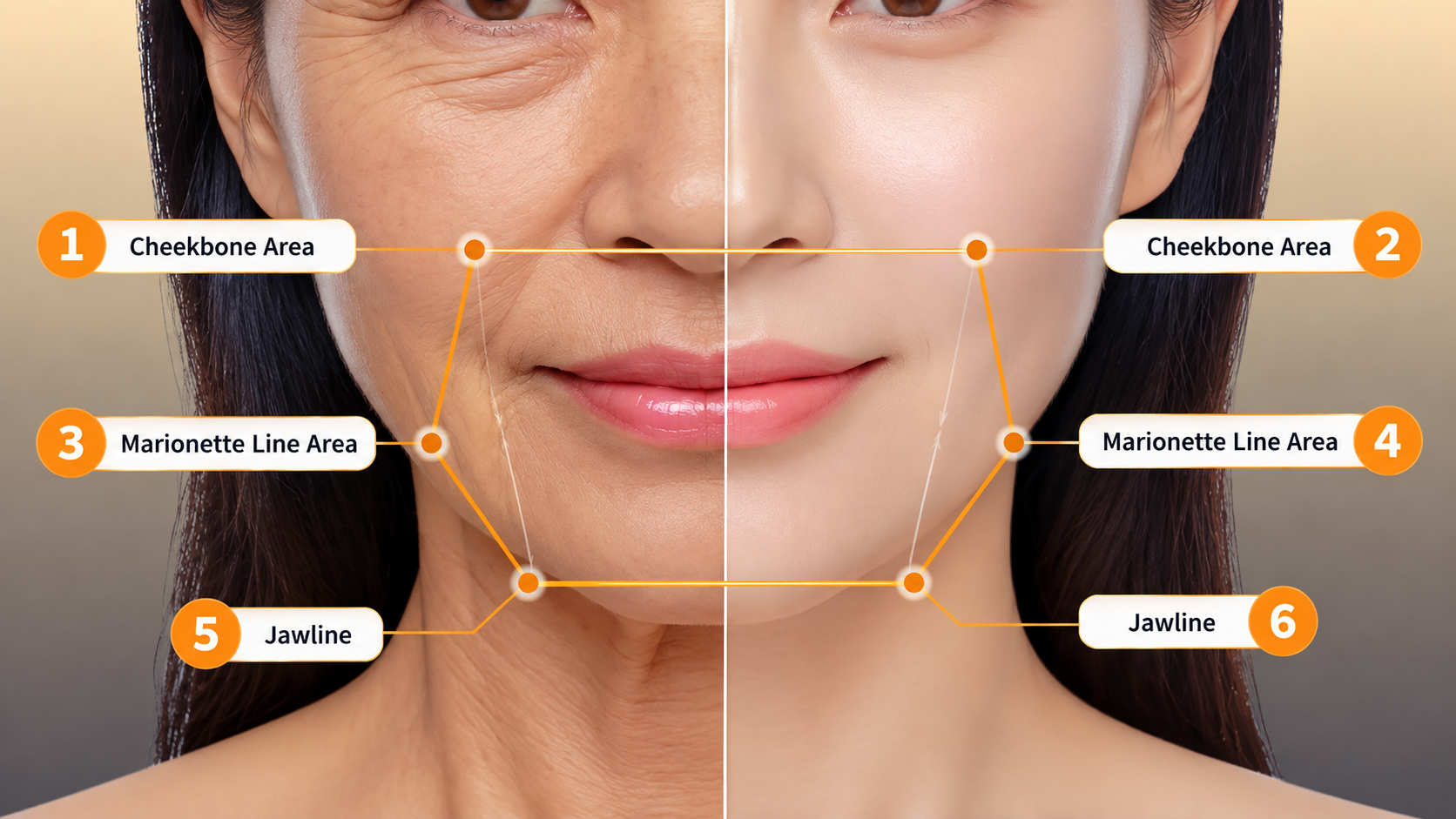
The clinician assesses skin thickness, elasticity, facial contours, areas of sagging, facial volume and the patient's goals before confirming Diamond Line Lifting as the appropriate treatment and planning the specific thread pattern, including how many threads to place and in which directions the lattice should run to address the patient's particular areas of concern. Some clinics apply topical anesthesia for comfort, and the procedure itself is generally performed without general anesthesia. Threads are introduced through small entry points using a fine needle or cannula, and the physician guides each thread along the planned path before anchoring it to create the supportive lattice.
The appointment itself is generally completed within a single visit, and most patients are able to leave the clinic shortly afterward without needing a companion to assist them, though this can vary depending on how many threads are placed and the specific areas treated. Temporary redness, warmth, swelling, tenderness, stiffness or sensitivity may occur after treatment, and some patients experience bruising or red marks; excessive heating is not a factor for thread placement specifically, but inappropriate technique can cause burns, prolonged irritation or pigmentation changes in rare cases. Some patients also notice a mild pulling or tightening sensation in the days following treatment as the threads settle into position, which generally resolves on its own without intervention. Recovery is generally short for non-invasive Diamond Line Lifting, with temporary redness, warmth, swelling or a stiff/tight sensation; some patients can cleanse and apply makeup soon after treatment, depending on the clinic's specific instructions. Before treatment, patients are asked to inform the clinic about medical conditions, medications, allergies, implanted devices, pregnancy possibility, recent aesthetic procedures and active skin problems, with the clinician assessing the skin before selecting final treatment settings.
Some tightening may be noticed immediately after treatment from the thread placement itself, while collagen-related skin improvement develops progressively over the following weeks as the body responds to the thread material. Many patients report that the visible improvement continues to build gradually for one to three months after the initial procedure, as the collagen response matures, rather than appearing all at once. Aftercare generally includes gentle cleansing, adequate moisturization and sun protection, avoiding unnecessary heat or irritating skincare procedures until the skin has settled, limiting strenuous facial movements or vigorous massage in the treated area during the initial healing period, and seeking medical advice promptly for severe pain, blistering, significant swelling or persistent skin changes.
Longevity and Maintenance
Diamond Line Lifting's results are temporary rather than permanent: the immediate mechanical support from the threads and the gradual collagen response both change over time as the thread material is absorbed and normal facial aging continues. Patients interested in sustaining their result are generally advised to discuss a maintenance timeline with their physician, since the clinic does not apply one fixed re-treatment schedule to every patient, and the pace at which a given patient's lattice is absorbed can differ based on skin thickness, metabolism and the specific thread material used. Some patients return for a repeat thread treatment once the initial effect has faded; others transition toward an energy-based technology in the specialty for ongoing maintenance, depending on how their skin and preferences evolve. A small subset of patients choose to alternate between thread-based and energy-based maintenance over successive years, on the view that the two mechanisms complement rather than substitute for each other, though this kind of long-term plan is always individualized rather than prescribed as a default.
Combining Diamond Line Lifting with Other Treatments
Combination planning for Diamond Line Lifting is handled individually by the treating physician based on the patient's specific concerns, anatomy and recovery timeline, since thread placement and energy-based treatments carry different recovery profiles that need to be sequenced carefully rather than scheduled together without planning. Patients who are also interested in volume restoration, pigmentation concerns or other skin quality issues addressed elsewhere at the clinic are encouraged to raise these goals during the same consultation, so that the physician can sequence any combined treatment plan appropriately rather than addressing each concern in isolation.
Safety, Precision, and Clinic Standards
SeouLeaguer Dermatology is a Registered Medical Institution for Attracting Foreign Patients, certified by Korea's Ministry of Health and Welfare under the Act on Support for Overseas Expansion of Medical Services and Attraction of International Patients (Foreign Patient Attraction Registration No. M-2020-01-58584). Thread-based lifting procedures of the general type used in Diamond Line Lifting are minimally invasive procedures whose safety depends significantly on the treating clinician's technique and judgment about thread type, placement pattern and depth; this is a different risk profile from the clinic's purely non-invasive energy-based technologies, and the clinic's inclusion of a board-certified plastic surgeon on its team is specifically relevant here. Possible risks include temporary redness, warmth, swelling, tenderness, stiffness, sensitivity, bruising or red marks, and less commonly burns, prolonged irritation or pigmentation changes.
The clinic's physicians review implanted devices, pregnancy, recent aesthetic procedures, medications, allergies and active skin conditions before treatment, and will decline or postpone treatment where a contraindication applies. Because thread placement is more technique-dependent than purely energy-based treatments, patients are specifically encouraged to discuss the treating physician's experience with thread-based procedures during their consultation, rather than assuming all providers offering "thread lifting" use identical technique or thread types.
The Bottom Line
In short, Diamond Line Lifting suits patients who want a minimally invasive, thread-based lifting option combining immediate mechanical support with a gradual collagen response, and who are comfortable with a procedure involving needles or a cannula rather than a purely topical or energy-based approach. It is best understood as one option among several within the specialty, with the right choice depending on individual anatomy, goals and tolerance for a more hands-on, technique-dependent procedure.
- Diamond Line Lifting places threads beneath the skin for immediate structural support plus gradual collagen stimulation.
- Recovery is generally short, with some patients able to cleanse and apply makeup soon after treatment.
- Results are temporary, developing progressively over the following weeks as the body responds to the thread material.
- Combination planning with other treatments is handled individually given threads' distinct recovery profile.
- Candidacy and thread selection are determined by the clinic's dermatologists and plastic surgeon together.
Frequently Asked Questions
**Is Diamond Line Lifting painful?**Some clinics apply topical anesthesia for comfort, and the procedure is generally performed without general anesthesia; patients may feel pressure or mild discomfort during thread placement.**How is Diamond Line Lifting different from the clinic's separate Thread Lifting service?**Both are thread-based treatments, and the choice between them depends on the specific thread type, pattern and treatment area the physician recommends for your anatomy, which is discussed directly at consultation.**How long is recovery?**Recovery is generally short for non-invasive Diamond Line Lifting; some patients can cleanse and apply makeup soon afterward, though temporary redness, swelling or a stiff sensation may occur.**When will I see results?**Some tightening may be noticed immediately from the thread placement itself, while collagen-related improvement develops progressively over the following weeks.**Who should avoid Diamond Line Lifting?**Patients with active skin infection, open wounds or significant inflammation in the treatment area should postpone treatment; those with certain implanted electronic devices, pregnancy, significant skin sensitivity or other medical concerns require individual assessment.**What should I ask the physician before booking?**It is reasonable to ask about the physician's experience with thread-based procedures specifically, since technique and judgment matter more for this treatment than for purely energy-based options in the specialty.How many days should I plan to stay in Seoul for Diamond Line Lifting? Given its generally short recovery, 1–2 days in Seoul is typically sufficient for the visit and a short follow-up, though this can be extended if combining treatments with different recovery timelines.
Book a Consultation at SeouLeaguer Dermatology
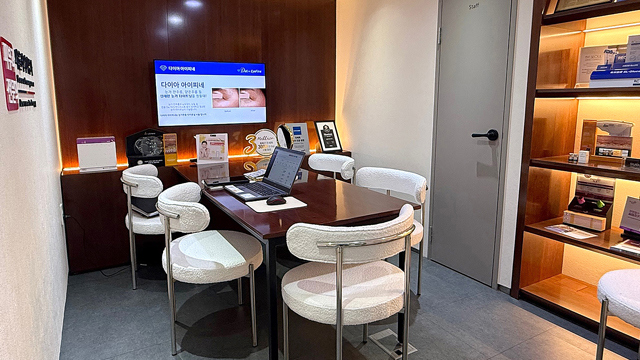
To find out whether Diamond Line Lifting or a different thread-based or energy-based technology fits your skin and goals, book a consultation with SeouLeaguer Dermatology's dermatology and plastic surgery team in Gangnam, Seoul.
Disclaimer
This page is for general informational purposes only and does not constitute medical advice. Individual results vary, and a qualified physician should assess your suitability for any treatment described here before proceeding.
Sources & Further Reading
Other Services
Explore additional treatments offered by our specialists.

Botox Injections for Wrinkles
Botox Injections for Wrinkles target the specific facial muscles whose repeated contraction, over years of expression, creates dynamic wrinkles.
Learn More

Oxygen Detox Care
Oxygen Detox Care is a non-invasive skin-care treatment designed to refresh and hydrate the skin using an oxygen-focused care method.
Learn More
Hyaluronic Acid Filler
Hyaluronic Acid Filler restores facial volume, smooths lines and folds, and enhances facial contours through minimally invasive injections.
Learn More